⚠ COLORADO: Orders placed on or after July 23rd are not guaranteed to arrive before the August 1st deadline. Important State Notices for Virginia, Colorado & New Jersey - Read More Here
Out of stock online
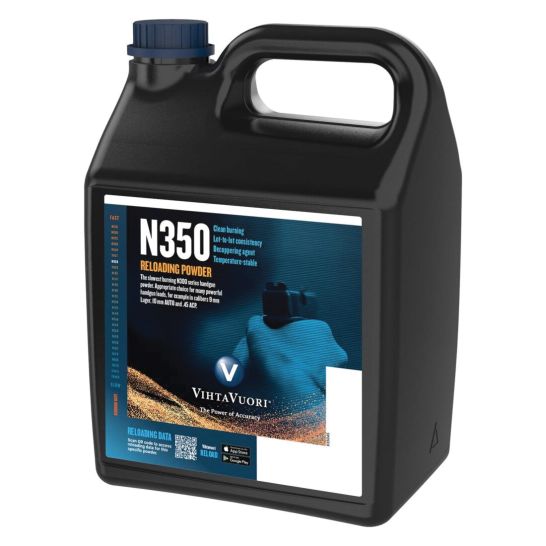
Vihtavuori N350 9mm/10mm/.45 ACP Smokeless Handgun Powder, 4 lb
Out of stock online
Vihtavuori N350 9mm/10mm/.45 ACP Smokeless Handgun Powder, 4 lb
| SKU | 51655206864 |
|---|---|
| Brand | Vihtavuori |
| MPN | T10075 |
| UPC | 06420615700777 |
CA WARNING (Prop 65) & Compliance Information
Please read before purchasing.
Please read before purchasing.
Product Details
Details
- Ecommerce Platform: Pistol
- Caliber 1: 9mm
- Caliber 2: 10mm
- Caliber 3: .45 ACP
- Size: 4 lb
Features
The unique characteristics of smokeless powder make it the preferred propellant for modern firearms, combining efficiency, safety, and power. Designed to burn rapidly and vigorously, smokeless powders provide the necessary force to propel a bullet with precision, ensuring a high-performance shot every time. Unlike traditional combustible materials, smokeless powder does not need oxygen from the air to ignite. The powder's chemical composition includes built-in oxygen, allowing it to burn completely even in the closed environment of a firearm's chamber, where access to air is limited. This ensures reliable ignition and powerful combustion, making smokeless powder ideal for use in ammunition. Upon ignition, smokeless powder generates a large volume of gas at high temperatures. When confined, as in a firearm's chamber, this gas can cause pressure to build up within the surrounding structure. However, the rate at which the gas is generated is precisely calibrated, ensuring that the pressure remains at a safe level as long as there is enough space for the gas to escape or dissipate. This feature distinguishes smokeless powder from high explosives like dynamite, which are designed to detonate rapidly, creating intense shock waves that propagate through any medium in contact with them. Smokeless powder, however, burns in a controlled manner, releasing pressure steadily and without the risk of detonation, making it much safer for use in firearms. The burning properties of smokeless powder are vastly different from those of black powder, which burns at a constant rate, regardless of confinement. Black powder generates a large orange flame and produces significant amounts of smoke and ash, leaving behind unburned particles that require additional cleaning. Smokeless powder, on the other hand, burns with little to no smoke and leaves behind minimal residue, providing a much cleaner and more efficient burn. When ignited under pressure, smokeless powder burns efficiently, with a small glow and very little residue, ensuring that the firearm operates smoothly and requires less cleaning and maintenance. The ability of smokeless powder to burn more efficiently under pressure makes it the optimal choice for modern firearms, ensuring a more consistent and powerful shot each time. To ensure the safe storage and transport of smokeless powder, the Department of Transportation (DOT) has established strict regulations for shipping containers. These containers are rigorously tested to withstand high temperatures and extreme conditions. During these tests, if smokeless powder is ignited, the container is designed to release the generated gases through controlled venting, either by splitting seams or popping off lids. This prevents the risk of an explosion while allowing for the safe release of pressure. The stringent safety measures in place guarantee that smokeless powder remains a safe and reliable product, even when exposed to harsh conditions during transport or storage.
- Efficient combustion
- Consistency across different lots
- Copper removal agent
- Temperature remains constant
Reviews
Q & A
Retail Stock
Compliance
Shipping Restrictions
It is the customer’s responsibility for understanding state laws regarding all purchases made. For a comprehensive list of all Shipping Restrictions, please refer to our Shipping Restrictions By State Page found Here.
All NFA Rules Apply
These items are controlled by the U.S. Government and authorized for export only to the country of ultimate destination for use by the ultimate consignee or end-user(s) herein identified. They may not be resold, transferred, or otherwise disposed of, to any other country or to any person other than the authorized ultimate consignee or end-user(s), either in their original form or after being incorporated into other items, without first obtaining approval from the U.S. government or as otherwise authorized by U.S. law and regulations.