

Our opening article may have been a lot to take in. When one decides to carry a concealed weapon, most people have gone through the potential ramifications of self-defense at this point in their lives. Still, now we get to what is possibly the most challenging part of Concealed Carry, Situational Awareness, and Mental Preparation.
All too often, people who obtain a CCW think that they will have the upper hand in a confrontation, and the mere possession of a handgun is a magical talisman that will protect them. They envision the “gentleman mugger” calmly asking them to hand over their wallet while holding out a rusty pocket knife as a weapon or pointing their finger under their shirt like a kid playing cops and robbers. The reality of this line of thinking is deeply flawed. The mind can either be your best ally or worst enemy; let’s focus on how to make it your best ally.
Situational Awareness

Criminals are predators. Like predators in nature, they stalk the herd, looking for signs of weakness. What will you do when you’re with your family coming back from a trip to the grocery store, and your hands are full of bags holding your food for the week when a gun is stuck in your face? What if you are attacked while shoveling snow and your firearm is under layers of clothing or safely on your nightstand? How will you react if you are confronted by a gang of criminals while changing a tire in the rain on the side of the road at night? These are times where situational awareness may not be at its peak, and an aggressor may think he has an easy target.
Colonel Jeff Cooper (USMC) identified that human beings go through various stages of awareness throughout their daily lives and identified each level as a color code. Cooper used this code to teach personal protection courses at the Gunsite Academy in the 1970s, and it has been used by most firearms instructors since. The Federal Government adopted a version of it to register terrorist threat levels in 2002.
Most people in modern society go around in what Cooper referred to as Condition White. That is, they are preoccupied and focused on something other than their surroundings. Their thoughts are not focused on their surroundings. People in this state overlook impending danger until it is usually too late.
The next step is Condition Yellow, when a person is alert and aware of their surroundings. Yellow is followed by Condition Orange when a potential threat has been identified, and the person is assessing how to deal with the threat.
Condition Red is at the top of Cooper’s list: the decision to use lethal force has been made. The USMC goes a step higher with Condition Black, meaning that the person is now in the fight.
Confronting a deadly attacker puts the body into a state of stress. The human body reacts to this by secreting adrenaline and triggering the “fight or flight” syndrome. Time can seem to slow down when this happens, fine motor skills are reduced to gross motor skills, and the ability needed for “target shooting,” such as breath-control and trigger-control, goes out the window. This is why some target shooters who can hit the 10-ring on the bull’s-eye all day long will scoff when they read an after-action report on a police or military shooting where hundreds of rounds are exchanged, and only four may hit their targets.
Making that mental leap from condition white to condition red can make the most mundane tasks seem difficult. Worse yet, the precious few seconds it takes for the mind to go from “la-la land” to a gunfight can make the difference between life and death. Everyone who decides to go armed needs to know how to mentally move up or down this scale seamlessly, depending upon their environment.
Conditional White

Condition White can take varying degrees. For some people, it is at the end of a workday, relaxing in front of the television or enjoying a meal with their family. In situations such as this, it is acceptable and perfectly normal.
More often than not, Condition White is brought about by being mentally preoccupied. Perhaps there is a deadline to meet at work, a family member in the hospital, or the excitement of going to a ball game. Anytime the mind is preoccupied with something not going on in the immediate surroundings is an excursion into the field of Condition White.
Criminals, by their nature, are predators, and predators choose their victims carefully. Most people think of this analogy in terms of a lion stalking a herd of antelope and looking for one that is injured or not as big or as fast as the others. However, predators such as crocodiles or pythons lie in wait and ambush unsuspecting prey. Criminals operate on a more visceral level than most people, mainly if the criminal is a sociopath.
A person walking around with their head down or talking on a cell phone sends a non-verbal message to human predators screaming: “I am unaware! I do not see you! You have the element of surprise!”
Criminals are more than willing to take advantage of a victim in this situation. Police reports after a mugging, strong-armed robbery, or attempted murder often recount the victim saying, “I don’t know where he came from.” Usually, the attacker was in plain sight and was not close to the victim by magic. The predator chose someone that looked like an easy target.
Condition White can be a dangerous state of mind. Beyond the scope of a potential crime, people in Condition White are the leading causes of traffic accidents, workplace accidents, missed deadlines, and other calamities. There is a time and place for being in this state of awareness (or lack thereof), which is usually behind several layers of security. The vital thing to be mindful of can ratchet up personal awareness a notch or two when needed.
It may be as dangerous as constantly walking around in Condition White; it is perhaps more difficult to do it at the higher end of the scale.
Condition Yellow

Condition Yellow can best be described as a relaxed state of alertness. It is best described as “vigilant without being paranoid.” A person at this level is conscious of a potential threat and is more observant of their surroundings.
In Condition Yellow, assessments are made. When driving through a school zone, someone in Condition Yellow will not only reduce speed but watch for a child to dart into the road. While enjoying a ball game, this type of person will take note of a crowd getting rowdy. Anyone in their immediate vicinity that is unusual or seemingly out of place will be scrutinized as a potential threat until it is assessed.
Someone in Condition Yellow may not expect to be attacked but is mentally prepared for the possibility. This individual will not be surprised or blind-sided because they are mentally alert and ready to take things to the next level.
Condition Orange

Condition Orange is the next level up from Condition Yellow. The person has identified a threat and has made their assessment. The threat does not have to be as overt as a gunman wearing a ski mask and toting a rifle into a bar; it can take the form of a loiterer in a dark parking garage in the path to the building’s entrance.
While in Condition Orange, it is essential to not focus solely on the threat. Criminals usually attack in groups; a person in Condition Orange will begin to formulate their plan for the immediate threat while conscious of another attacker lying in wait. The subject is mentally prepared to deal with an attack while at the same time aware that it could be innocuous.
As stated earlier, criminals are predators. If that lone individual is a criminal, he will often wait for a suitable victim who appears weaker or unaware. However, if that criminal is a sociopath and is not dissuaded by an alert subject, then the subject needs to jump immediately to Condition Red.
Condition Red

Condition Red means that the subject is ready to fight and knows how to deal with the threat. This is the final step before the actual conflict, and the issue is fully committed to action if needed.
As the subject approaches the lone individual while on his way to the entrance, he may think: “If he asks me for money, I will smile and say, ‘No, sorry’ and keep walking. If he gets physical, I will respond with force. If I see a weapon, I will shoot him”. If the loiterer turns out to be someone who locks their keys in their car and waits for a locksmith to open their door, the subject mentally de-escalates back to Condition Yellow.
It is possible to go through all these stages and back down without ever resorting to direct action. The goal of moving from one state of awareness to the other is to increase reaction time. Reaction time is crucial in a fight and is 90% mental. It can take as long as 5 seconds to go from Condition White to Condition Red and some fights are over as soon as three seconds.
Conditional Black
Condition Black means taking direct action. This can be as simple as changing a route or leaving the area. In some situations, it may mean running away. However, when left with no escape route or the only option is to use force, the subject must commit to meeting the threat head-on and putting their plan into place.
MSgt Paul Howe, a former Delta Force Operator and Somalia veteran, has an excellent summary for this: “If you want to pray, pray before the fight, or pray after the fight. But when you are in the fight, you fight.”
While in Condition Black, the subject must deal with the immediate threat while still conscious of additional dangers. This is easier said than done as the human brain tends to focus on one thing at a time. Veterans of gunfights will refer to this erroneously as “tunnel vision.” This gives the impression that the eyes are only focusing on one thing at a time. The brain processes what the eyes see and rejects what it does not deem necessary for immediate survival.
Mental Preparation
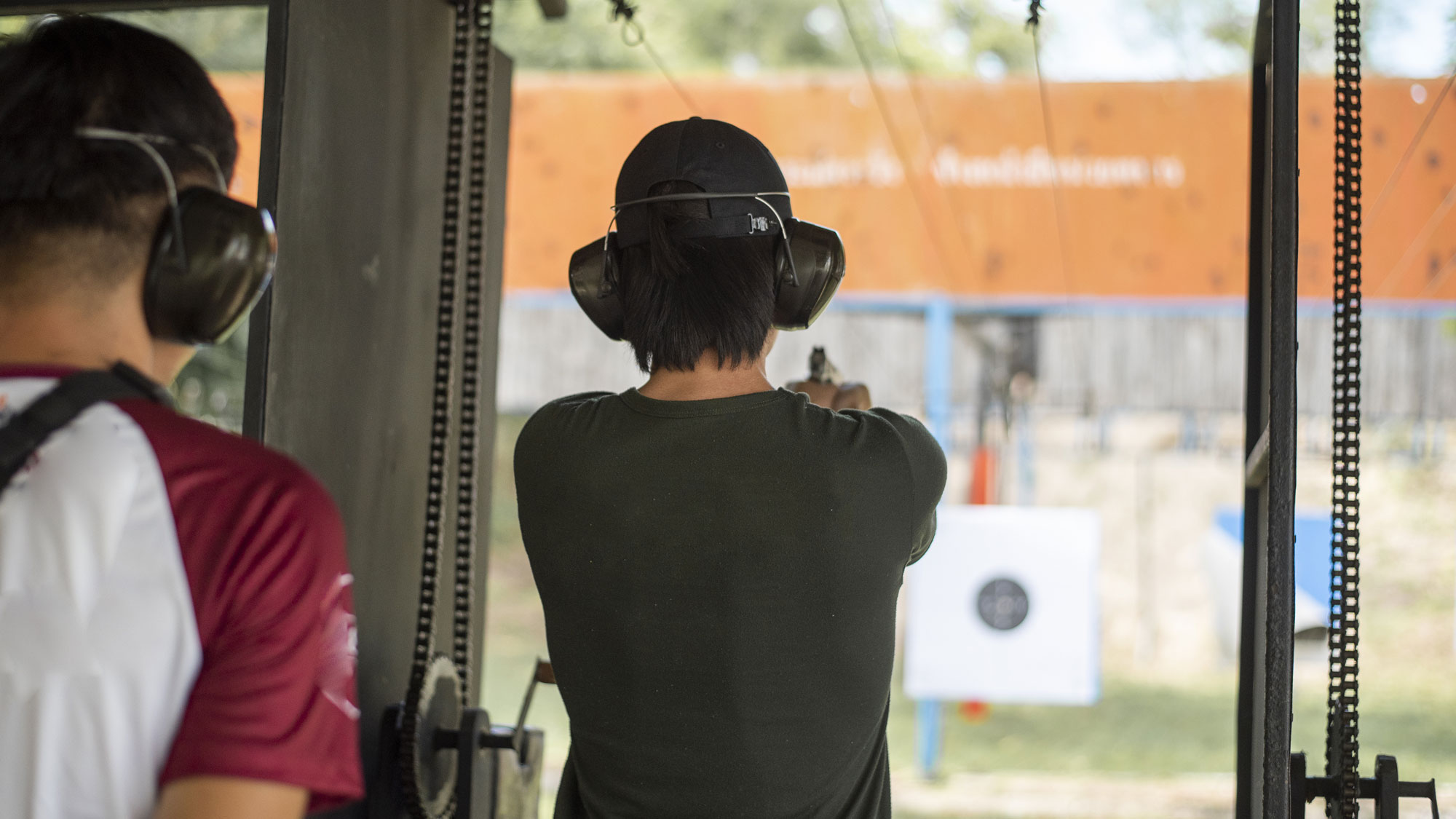
One of the most challenging things for a shooter to overcome is the thought of centering their sights on the chest of another human being and squeezing the trigger. Holding the power of life and death in his hands can be an obstacle to a CCW holder, as the conscious thought of taking a human life is not easy.
The CCW holder must come to terms with this and realize that lethal force may be a necessary evil when dealing with a criminal.
From a moral point of view, that can be a matter of Faith. It is advised that if a CCW holder holds to the tenets of a religion, they seek spiritual guidance regarding when killing another human being is justified. Some belief systems have that it is justifiable when in defense of self or others, whereas different belief systems never find killing excusable regardless of circumstances. The time to determine this from a faith and morals perspective is before the CCW holder decides to carry a firearm.
With the morality question settled, the prospective CCW holder must then understand the legality of deadly force in their jurisdiction or any jurisdictions where they may travel. Rules of deadly force can vary from state to state and even from city to city (or county or municipality) within those states.
In most instances, this is outlined on the official websites of the jurisdictions in question. In most locales, a shooting is justified when in defense of self or others. Some cities or states stipulate a “duty to retreat,” meaning that the CCW holder must exhaust all avenues of escape before shooting is justified. Other states have what is known as “stand your ground laws” in place, where there is no requirement to escape.
There is another factor relating to the disparity of force and judicious use of force. What this means is that the action chosen must be proportional to the threat. For example, you cannot shoot and kill someone who has only called you a jackass in a road rage incident.
It is paramount that the CCW holder is familiar with these laws in any jurisdiction where they go armed.
Recognizing the Threat

A threat can come in a multitude of different sizes, appearances and originate from any number of situations. One can not walk out into the world and always be prepared for every possible threat. Still, we can try to anticipate it better if we can identify certain red flags or abnormalities in our surroundings. When encountering a person or situation, look for these characteristics to help determine when you may be under threat.
- failure to conform to social norms
- being deceitful and/or manipulative
- impulsive, inability to plan ahead
- Irritability and or aggressiveness
- reckless disregard for the safety of self or others
- consistent irresponsibility
- lack of remorse after having hurt, mistreated or stolen from another person.
By looking for these behaviors and traits, one can more quickly identify someone who could be a potential threat.
A mantra used by every fighter from Boxer Mike Tyson to the UFC’s Connor McGregor. “You must throw all of your punches with bad intent” – fully committed to defeating your enemy. This line of thinking can be carried over to self-defense with a handgun and will be dealt with further in next week’s third and final article.
South Carolina and North Carolina residents, get your Concealed Carry Permit at a Palmetto State Armory location near you.
Check out Conceal Carry Basics Part 3 and learn about topics such as firearms training, the proper shooting mechanics, and malfunction drills. If you missed Conceal Carry Basics: Part 1, we covered CCW firearms, ammo, carrying techniques, and more.