The Difference Between 5.56 & .223

Share:
What is the difference between the 556 and 223 rounds?

People argue about .223 Remington vs. 5.56×45mm NATO every time they crowd around a gun counter. They look similar and use the same bullet diameter, but key differences in chamber dimensions and pressure set them apart. 

History: Which came first — .223 or 5.56?

  • .223 Remington was developed in the late 1950s as an offshoot of the high-velocity .222 Remington varmint round. The .222 and its derivatives were extremely popular with benchrest and varmint shooters; the parent .222 even set a 100-yard world record group that stood for decades.
  • Remington later created the .223 Remington (by modifying the .222 family) for higher velocity and improved performance.
  • The U.S. military took interest in the cartridge, and after further development the round was standardized by NATO as 5.56×45mm NATO. That military adoption introduced changes to load pressures and chambering that led to the two cartridges being similar but not identical.
Technical Differences Explained

  • Pressure: 5.56×45mm NATO is typically loaded to higher pressures than .223 Remington. (Common SAAMI/COP values used for comparison are in the range of ~58,000 PSI for 5.56 vs ~55,000 PSI for .223 — the important takeaway is 5.56 is hotter.)
  • Chamber throat / leade / shoulder: 5.56 chambers usually have a slightly longer throat (the distance the bullet travels before engaging the rifling) and slightly different shoulder position. That changes how pressure develops when a round is fired.
  • Dimensions & specs: Because of throat/shoulder and pressure differences, the cartridges are dimensionally and performance-wise distinct even though they use the same bullet diameter and often the same projectiles.
  • Bullets: Externally, the bullets are the same diameter; differences are internal (pressure, chamber). That’s why they can look interchangeable at a glance.

Are 5.56 and .223 Interchangeable?

  • .223 ammo in a 5.56-chambered rifle: Generally safe. Many 5.56 chambers will handle .223 without issue.

  • 5.56 ammo in a rifle marked .223 only: Not recommended. The higher pressure and differing chamber dimensions of 5.56 can create unsafe conditions in rifles designed strictly to .223 specs.

  • Reality in modern firearms: Most new production rifles are built to tolerances or chambers (like .223 Wylde) that accept both safely, which is why many shooters never have a problem. But not all rifles use Wylde or 5.56-rated chambers, so don’t assume — always verify.

What is .223 Wylde and why does it matter?

  • .223 Wylde is a chamber design created to be a safe, accurate compromise between .223 Remington and 5.56 NATO.
  • It uses a throat/leade dimension that allows safe use of both .223 and 5.56 while usually improving accuracy compared to a standard 5.56 NATO chamber.
  • Many modern AR-pattern rifles are built with a Wylde chamber to give shooters flexibility.
Practical Shooting & Performance Notes

  • Accuracy / point of impact: Differences are usually small. Switching between .223 and 5.56 can shift your point of impact (POI) slightly even if bullet weight and type are identical. If you zero your rifle with one round, re-verify your zero after switching.

  • Velocity & felt performance: 5.56 loads often produce slightly higher velocity because of higher pressure; you may notice small changes in velocity and recoil, but for most recreational shooters the difference is minor.

  • 99% rule (practical): Many modern guns can safely shoot either round because of Wylde or 5.56-rated chambers — but not all. Treat “most” as common, not universal.

Safety Checklist Before You Shoot

  • Check the barrel stamp. It usually states chambering (e.g., “.223 Rem,” “5.56 NATO,” or “.223 Wylde/5.56”).
  • Read the owner’s manual. The manufacturer will tell you what ammo is safe to use.
  • Contact the manufacturer if markings and documentation are unclear.
  • Never fire 5.56 in a rifle marked only “.223.” If you’re unsure, don’t shoot it.
  • If you plan to run both rounds regularly, prefer rifles with a .223 Wylde chamber or barrels explicitly marked for both.

The Bottom Line 

.223 Remington and 5.56×45mm NATO are close relatives — they share bullet diameter and much of the same external appearance — but differences in chamber design and pressure make them distinct cartridges. For many shooters using modern rifles (especially with .223 Wylde chambers), running either round is routine and safe. Still, the correct practice is simple: check your barrel and manual, know your chambering, and don’t assume interchangeability. Safety first, then performance.

FAQ — Quick Answers

  • Can I shoot .223 in a 5.56 rifle? Yes, usually safe.
  • Can I shoot 5.56 in a .223 rifle? No — avoid doing so unless the rifle is rated for 5.56.
  • Will my point of aim change when switching? Possibly. Always re-zero when changing ammo types.
  • Why do they use the same bullet if they’re different? The projectile diameter is the same; the differences are in chamber dimensions and pressure, not bullet size.
Related posts
Comments
Taylor
Loading...
I know it would lead to some confusion on the subject, but could you include some information on the 223 Wylde chambering?
Dion White
Loading...
223 Wild has better tolerances for both the two to three and five five six round. From a headspace issue. It just helps with the chambering
T.C. Brooks
Loading...
Simply means that you can use either cartridge . 223 Rem. or 5.56 Nato
Tom Scott
Loading...
The statement about a civilian rifle not standing up to a military grade cartridge only holds true for 5.56x45. The 308 Win is a higher pressure round than the 7.62x51 Nato cartridge therefore the whole concept is reversed. You can shoot a 7.62 Nato round in a 308 but not safe to shoot 308 in a military chambered 7.62.
Todd Koeppel
Loading...
The same could be said for .30-06. It is not advisable to shoot civilian .30-06 from your M1-Garand due to the increased pressures in the civilian loads as opposed to the military version.
pc macdonald
Loading...
This is not due to increased pressures. This is due to a longer pressure profile moving the pressure peak from early to late down the barrel, over pressuring the gas system and often tweaking the op rod.
Jeff
Loading...
Why didn't the author bring up the shoulder angle difference which is obvious in the pictures. Pressure may be an issue, but stove piping a 5.56 in a .223 chamber, to me, has always been the bigger problem. Side by side pressures comparisons aren't the big of a difference with factory charges. That's why the Dylan chamber came about, splitting the shoulder angle differences. .308 Win has higher pressure than 7.62 NATO. The NATO cases of both 5.56 & 7.62 have steeper shoulder angles and that moves leads of jump.
Jeff
Loading...
*Wylan chamber* damn sp check
pc macdonald
Loading...
errr..... \"WYLDE\" chamber.
Steven
Loading...
There is no shoulder angle difference between the two cases. They are for all intent purposes identical.
Tom Scott
Loading...
There is absolutely no difference in outside dimensions between the two cases. Not in 5.56 vs 223 or 762x51 vs 308. Exact same dimensions. And it is not a Wylan chamber, it is Wylde.
Jb
Loading...
Am i the only person reading this in the voice of gunny?
PAMAX Tactical
Loading...
This article muddies the waters. It holds true to old manufacturing but now almost all .223 barrels are .223 Wylde. Barrel Markings .223 Wylde = 5.56 Nato and .223cal 5.56 Nato = 5.56 Nato and .223cal .223 or .223 Only = .223cal
pc macdonald
Loading...
'Taint so. WYLDE is common, sure. And you won't find one in a bolt gun.
Kat Clark
Loading...
Makes me glad my M4 A3 was chambered for 5.56 nato.
Rick
Loading...
If using 556 brass but loading to 223 load specs will there be a problem with use in a 223 because of pressuse due to smaller case capacity ? Thanks
Lee Samuelson
Loading...
https://www.youtube.com/watch?v=VCS4fXFmCyA
Loading...
So, I'm assuming that I can use a shell marked 5.56 when I reload to 223.
Mike
Loading...
Yes you Can use 5.56 brass, but you must run the 5.56 thru a full length 223 resizing die, then trim the shell to proper length, and you are ready to reload. If you do not follow this process, the cartridge will not fit in a 223 chamber. If you full length resize you should be able to use it in either 5.56 or 223. Chamber
pofinmt
Loading...
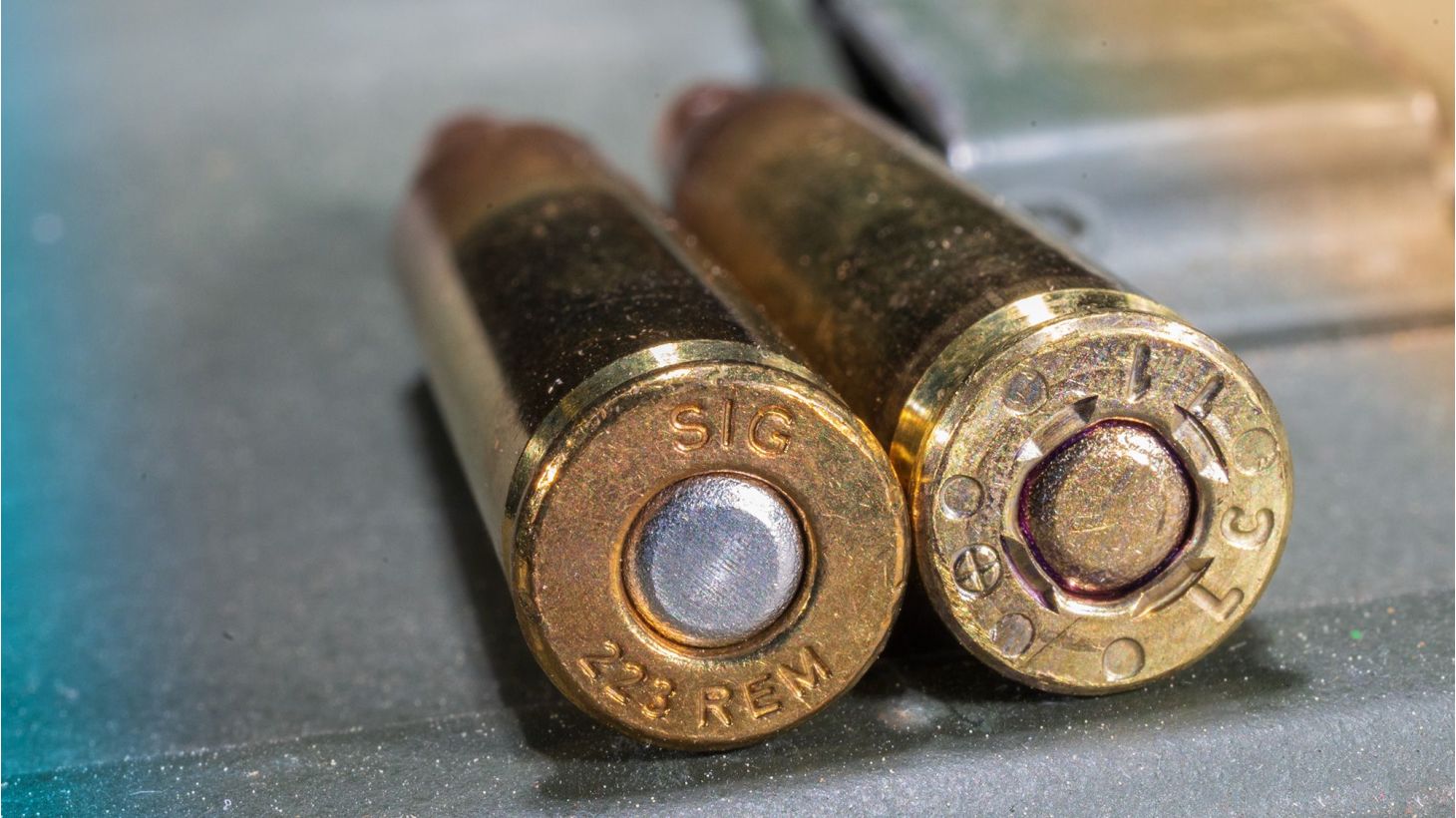
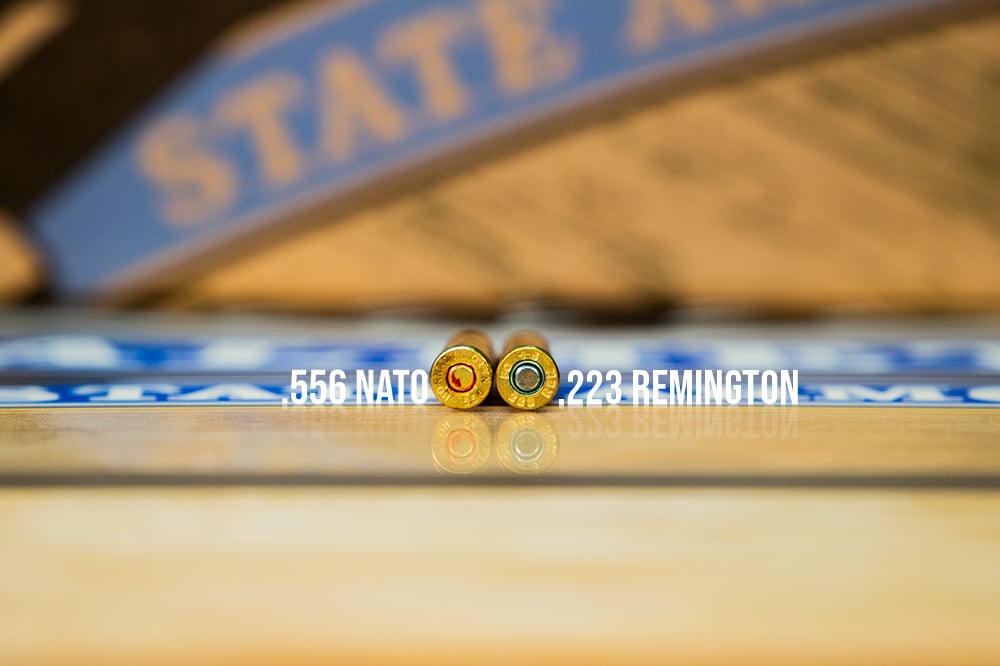
In the second picture down from the top the labeling seems to be reversed. From other articles I have read, the 5.56 has the crimp ring that the .223 does not.
T.C. Brooks
Loading...
Bought a Savage Axis II in Troy Al. about two mos. ago . The problem I had was 2 out of every 10 rounds might fire. The problem area is in the bolt body. Savage uses a molded washer around the forward end of the firing pin and inside the bolt body drag between this washer and the wall of the bolt body occurs resulting in a light primer strike. I did some polishing and clearance work in this area and haven't had a light primer strike since . In ref to the .223 Rem & 5.56 diff. I have a savage bolt gun in .223 Rem and it has such a long leade that it is longer than the military 5.56 chamber in the AR 15 /16 rifle ! A shooter needs to know this before firing his or her non military rifle rifle .
Outsidejim
Loading...
I disagree. A few decades ago this article may have been accurate, but not today. While SAAMI specs may indicate different maximum pressures, the EU doesn't recognize SAAMI and has a different standard. In the EU specs, if a firearm can chamber a round, it must be engineered to the maximum pressures possible for the round. All .223 rifles will chamber a 5.56, and no manufacturer is going to exclude their product from the European (NATO) market. Therefore all manufacturers will engineer to the higher pressure possibility. In addition to that, pressures will vary depending upon the weight of the bullet. All engineering will be done to heaviest bullet weights in order to reduce liability. I'll continue to have complete confidence in modern firearms chambering and safely firing both rounds. For older firearms, certainly pre 2k, caution may be prudent.
Michael Gilbert
Loading...
Thank goodness some sanity came through. I have found by tickling max load data and creating leade differences have frequently created better accuracy. I've never encountered any pressure signs from this practice or shooting 5.56 in a .223 chamber. I just wish the industry would all have presence of thought and good design to standardize at 1 to 7 twist to get the most out of these firearms. \"Only accurate firearms are interesting.\"
Fred Colantuoni
Loading...
I was in the Army Infantry in Vietnam. I wonder why all the ammo issued to us for the M16 was marked both 5.56 and .223?
M. Cantera
Loading...
At that time there was only one specification: MIL-C-9963, MILITARY SPECIFICATION: CARTRIDGE, 5.56MM, BALL, M193 The M193 as the the same as the same as the civilian cartridge. A 55 grain projectile loaded to 55,000 psi. The whole silliness came about as the result of the NATO trials, which required the penetration of a Soviet helmet at 400 meters. The Belgians came up with a 5.56 SS109 62 grain steel tipped round loaded to a higher pressure. That was adopted as the M885 \"green tip\" of today.
Patrick Kennedy
Loading...
See spellz checks hates youz too. I thunk it was only me!
Patrick Kennedy
Loading...
A Mil Spec 5.56 case has less internal volume than a 223 Rem. If you do a water volume test you will see. Same on 7.62 vs 308. Mil Spec 30-06 vs civilian brass, same thing. Mil Spec brass is stronger and thicker near the back of the case thus decreasing the volume. Load a Mil Spec case to max civilian pressures and you are at a unsafe pressure. One sees this when modifying 5.56 to 300 Blk Out. The crimp in the Mil Spec case is to keep the primer in the case during rapid/full auto fire and the thicker back of the case is to keep brass rupture out of the picture. A full auto stops real fast when a primer pops out. The upside of the smaller case volume is that less powder causes the same velocities as compared to civilian brass. Patrick (I am not an old know-it-all but I portray one in real life, so says,my wife.)
zack p vandyke III
Loading...
Absolutely, totally correct!!!!
Philip J Broome
Loading...
I think all these guys like to hear themselves talk.. lol But I do find it interesting
Robert Lee Wood
Loading...
The round given to me for the weapon does not look like either, I was told it was a 5.56 round but it is a shorter fatter round on the end without the beveling down at the end
Jack Anderson
Loading...
Thank you guys for all great information....I'm considering buying an AR style rifle....God bless!