

I’ve never been in a knife fight or stabbed, so I’m not an expert and don’t claim to be. After a career in the military and time as a private military contractor in Afghanistan, I know enough to carry a tactical knife wherever I go.
For those reading this article who are experts and martial art instructors with an emphasis on knife use, you may find the information to be elementary, but I hope you find some value in it somewhere. This article is mainly for the uninitiated or “new to blades” to give them something to think about and work with.
Guns fail to function, and you can carry only so many rounds, but a blade’s cold steel will always work if you have resolve and violence of action.
What Defensive Knife Should You Choose?
Before I answer your question, you need to first answer my question: Are you prepared to even go ‘there’ if all you have is a knife?
Nothing is more visceral and primal than the thought of slicing or stabbing another human being. Almost all of my contemporaries, including myself, would rather be shot than stabbed. Before you decide to carry a knife to defend yourself, you will first need a warrior mindset.
The maximum effective range of a knife is arm’s length, so it will be an intimately violent affair. I certainly don’t want to go down the rabbit hole of scenarios, but the situation may be, at best:
- A person is physically assaulting you, and for whatever reason, all you have is a knife.
- You have a firearm, but it’s inoperable. For those that say “run away,” what do you do if you’re injured and can’t run or with someone that can’t run.
Folding Knives

Let’s talk about one type of knife almost everyone carries.
Folding knives are great because they “fold” into a footprint half the size of when opened, and most folks like having them. Go to any range, and you will see the telltale clip of a folder, typically on the outside of everyone’s strong side/gun hand pocket.
Some folders, more than others, may lend themselves to defensive applications, but all folders “fold” at a pivot point which is their Achilles tendon as far as strength. Have you ever had a lock on a folder fail and the blade close or almost close on your fingers? With a folding blade, you have to open the knife and be sure it is “locked” before you can use it without concern that the edge may close on your fingers.
Are some folders better suited to defensive uses than some fixed blade knives? Certainly, but my goal is to point out the forest through the trees. There are plenty of great folders out there, and they are great for concealability, but true defensive folders are far and few between.
Fixed Blade Knives
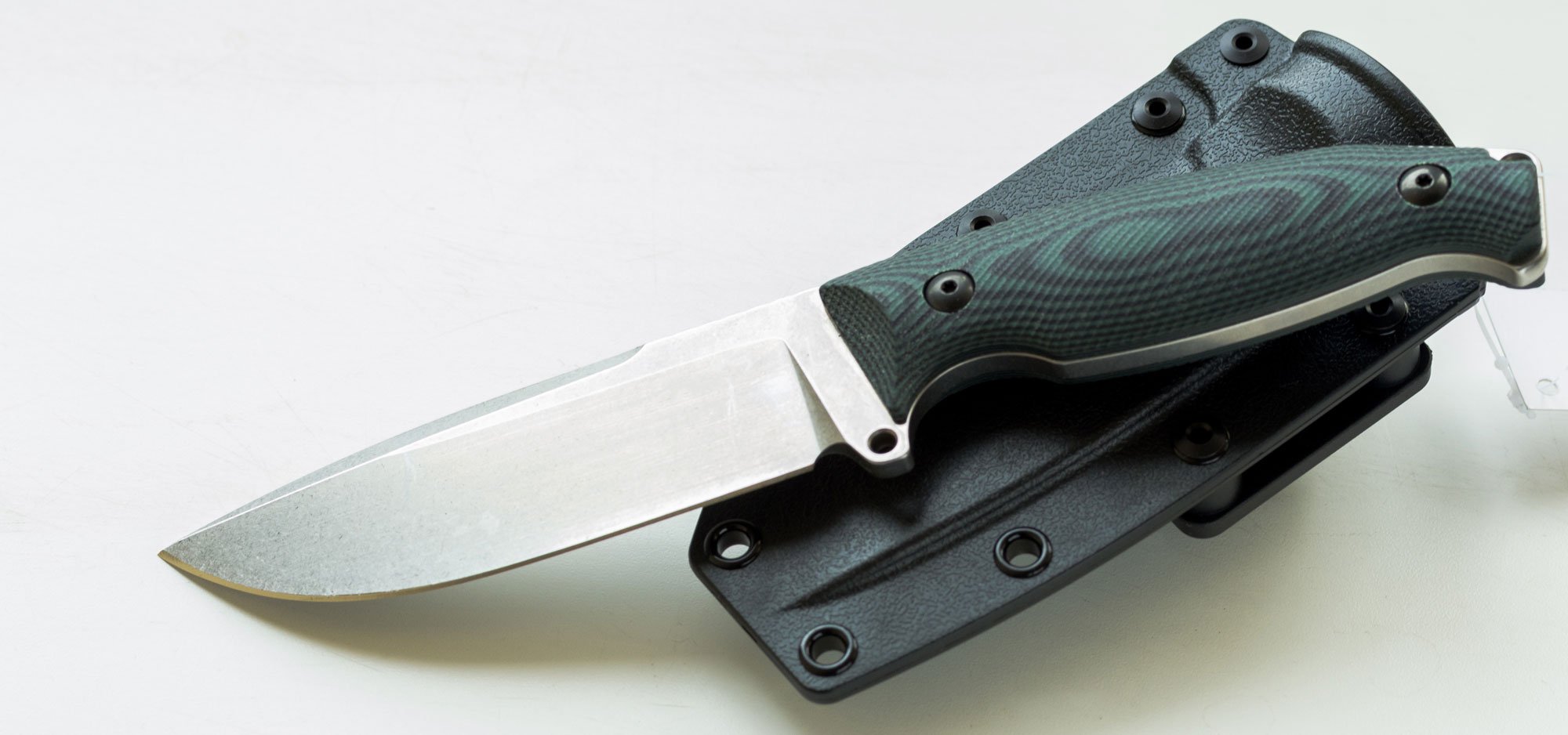
The strength of a fixed blade knife comes from the metal in the blade (tang) that extends through the entire length of the grip to the knife’s pommel (butt end). One of the things to look for in a fixed blade is a “full tang.”
Strength being relative, many folders are undoubtedly tough, but they will never take the beating that a solid, full tang, fixed blade will. Regarding defensive applications, another reason I recommend a fixed blade is the speed of deployment.
In an emergency, you want a knife ready to go the second it is pulled out of its sheath. A fixed blade knife is better than a folder when speed and safety are essential. I will safely say the “best” folder isn’t as reliable or quicker to deploy as a good fixed blade knife.
What is the Main Purpose?
This will be hard for some of you to wrap your heads around, but in particular, your EDC fixed blade defensive knife is just that. It’s a tool, just like your gun, that you carry and maintain ONLY for defensive use. Like your gun, you pray that you never have to use it. Use another knife (your folder) for everyday utilitarian tasks.
EDC Knife Recommendations
I have amassed several folding and fixed blade knives over the years. Below is a representation of four fixed blade knives I have carried and still do.
There’s a lot of subjectivity to what’s considered good. What I like and find aesthetically appealing to me might not be the same for you.
I try to categorize defensive tools into either good, better, or best, but a particular knife that might be best for one situation might only be good for another situation for many reasons.
I only included what I felt was the most pertinent information, such as brand, model name, blade length, and total length. The material that the sheath, handle, and metal used for the blade are also equally important but are readily available on the respective websites of each knife maker.
For reference, the picture of each knife is a standard 30-round AR magazine approximately 7.25 inches long.
Spyderco Pygmy Warrior
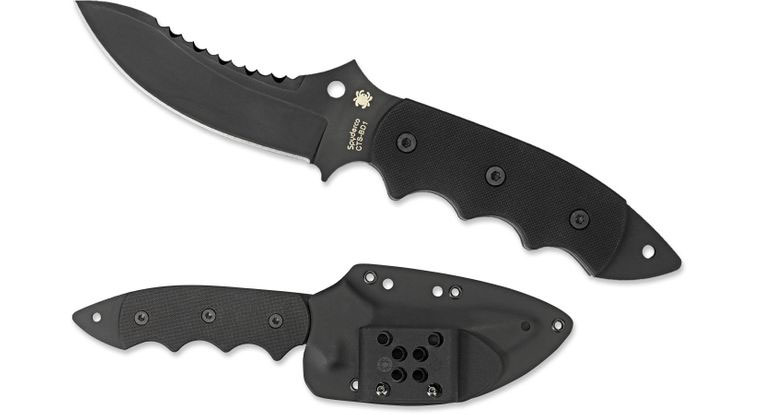
The blade’s curve is computer engineered to replicate the natural arc of motion of the human arm and ensure maximum energy transfer during a slash or thrust. An aggressive series of sawteeth on the back of the blade also provides extreme traction when used with reverse-grip trapping and hooking techniques.
One of the unique features of this knife is the stackable handle construction, which consists of two outer scales and two spacers that allow you to custom-tune the grip size to your hand. This highly evolved close-combat tool includes a custom-molded sheath equipped with a versatile Spyderco G-Clip™ attachment that supports angle-adjustable belt or inside-the-waistband carry.
- Total Length: 9.30”
- Blade Length: 4.57”
Pros: The Pygmy Warrior is a purpose-built defensive carry knife for the above reasons.
Cons: Its size may make it harder to keep concealed. It is the largest of the defensive knives I will present in this article.
Boker Plus Tac-Neck
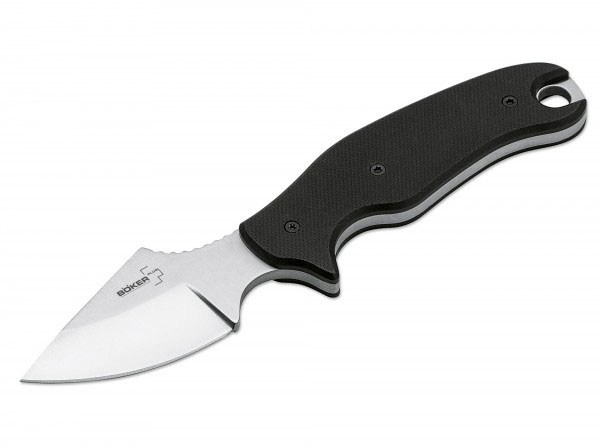
The Tac-Neck has a slim and compact design for comfortable carry.
The handle is large relative to the total length of the knife and well contoured to provide a secure and comfortable grip.
The grip-to-blade ratio provides a very effective force transfer with the smaller clip point and blade size. The Tac-Neck is designed and touted to be a “neck knife” also, but for some people, it might be on the large size to make that a practical application for carrying.
- Total Length: 6.30”
- Blade Length: 2.60”
Pros: The Tac-Neck size and very well-contoured grip will be something most readers will find appealing. Some might be concerned about its length out of the box, but with the narrow grip, those concerns shouldn’t last long.
Cons: Some of our readers may prefer a longer blade for aesthetic reasons.
CRKT Keramin
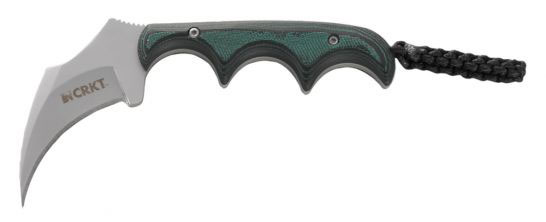
The CRKT Keramin (Karambit style) blade is designed more for slashing and lends itself well to defensive situations.
With the Keramin, as well as any other knife you might be considering for a defensive EDC, the best grip strength can only be obtained when all five digits work in this coordinated manner; the thumb wraps around and over the index/middle fingers and the ring/small fingers squeeze down tightly.
Pros: The Keramin blade design and the recommended grip make this choice an excellent knife for defensive purposes. Overall, its size lends itself to concealability too.
Cons: Karambit-style blades are hit or miss with most folks. Also, a possible con is if you are considering the Keramin and use it for utilitarian purposes and not a dedicated defensive knife, the blade tip being needle-sharp, may break off.
Benchmade Adamas CBK Push Dagger
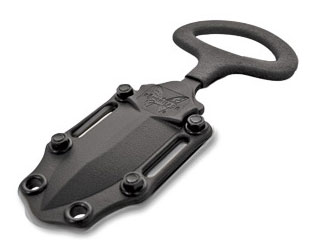
The Adamas 175BK is a double-edged push dagger. The large, somewhat T-shaped, open handle is a rubberized type coating for excellent grip. The Adamas is meant to be held in your hand so that the blade protrudes from your fist between your index and middle finger.
As this is the last of the EDCs I will present, I wanted to point out that when making a blade purchase, it’s just as important to look at the sheath in your selection. The sheath is half of your overall purchase; think about that. The blade can be excellent, but if the sheath isn’t a good platform, the blade may fall out, or the entire unit could fall off whatever you secure.
Of the 5 knives, the Adamas sheath is pretty impressive as the mounting bracket is steal secured to the entire back face of the Kydex sheath with 4 bolts.
Total Length: 5.47”
Blade Length: 2.50”
Pros: The Adamas has an excellent mounting system secured to its sheath, so this blade can be carried without losing it for most applications. The overall footprint is flat, so it lends itself to concealability too.
Cons: The push dagger style grip, deployment, and use may off-put some as it’s not a traditional knife.
Wrap-Up
Is it worth it to carry a dedicated defensive fixed blade knife? Did I give you some points to ponder? Do you already have a dedicated defensive knife but maybe learned a few things?
At this point, we looked at four great fixed blade defensive knives of various sizes that could be considered “Good,” “Better,” or “Best” depending on several factors.